If you are running some workloads on AWS and thinking about adding another cloud provider, you are not alone. According to Gartner research, most enterprises become “accidentally multi-cloud” before they ever have a clear strategy — through acquisitions, different teams choosing different tools, or simply running trials and never cleaning them up.
But “accidentally multi-cloud” and “strategically multi-cloud” are very different things in cost, complexity and outcome.
This article is not trying to push you in either direction. Its purpose is to help you answer a practical question: at your SME's current size and with its current resources, is multi-cloud the right choice or expensive over-engineering?
1. What is multi-cloud? How does it differ from hybrid cloud?
The two terms are often used interchangeably but have clearly different meanings, and the confusion frequently leads to the wrong decision.
Multi-cloud is a strategy of using services from two or more public cloud providers for the same type of workload. For example: running an app on AWS, using HiTechCloud for AI workloads because its GPUs are cheaper and the data needs to stay in Vietnam, and using Cloudflare for CDN. All of these are public cloud — just from different providers.
Hybrid cloud combines on-premises infrastructure (or private cloud) with public cloud. For example, a critical database runs on a physical server in the office while the web application runs on the public cloud. Hybrid cloud is about connecting on-premises infrastructure with the cloud — it does not necessarily involve multiple cloud providers.
Quick comparison table:
| Multi-cloud | Hybrid cloud | |
| Number of providers | ≥ 2 public cloud | 1+ public cloud + on-premise/private |
| Core problem it solves | Avoid lock-in, best-of-breed | Connect legacy systems with the new cloud |
| Complexity | Cao | Medium to high |
| Right for SMEs? | Conditional | Usually a better fit |
Many Vietnamese SMEs are in fact running hybrid cloud (on-premises servers plus some services in the cloud) but call it multi-cloud. Telling the two apart helps you pick the right strategy for the problem you actually have.
2. Why Vietnamese SMEs are actually considering multi-cloud
Unlike the textbook theory of “vendor lock-in avoidance” and “best-of-breed selection”, Vietnamese SMEs usually look at multi-cloud for far more specific and practical reasons:
Reason 1: compliance and data sovereignty.Data Law 2025 (Luật Dữ liệu 2025) and PDPL 2026requires certain categories of sensitive data to be processed on domestic infrastructure. If an SME runs its entire workload on AWS Singapore, that is a mandatory trigger to consider adding a domestic cloud provider — not because multi-cloud is desirable, but because compliance requires it.
Reason 2: GPU and AI workload costs.Startups and tech SMEs are building more and more AI features. GPUs on AWS or GCP cost considerably more than on some domestic providers or specialized GPU clouds. Using a separate provider for AI training and inference while keeping the main application on the existing provider is a common pattern.
Reason 3: Latency for users in Vietnam.AWS Singapore has higher latency for domestic users than a data center in Hanoi or Ho Chi Minh City. For consumer apps or SaaS with a large Vietnamese user base, adding a CDN or placing some workloads on a domestic cloud is a reasonable move.
Reason 4: disaster recovery and redundancy.Some SMEs want to avoid depending entirely on a single provider — if one provider has a prolonged incident, they can fail over to another. This is a legitimate reason, but how necessary it is tends to be overestimated.
Reason 5: teams adopt many different tools on their own.The most common reality: marketing uses a SaaS product running on Azure, engineering uses AWS, and the data team is trying GCP for BigQuery. This is “accidentally multi-cloud” — not a strategy, but entropy.
3. The real risks: complexity, cost, skills gap
Before committing to multi-cloud, look honestly at what you are taking on:
3.1 Complexity grows exponentially, not linearly
With a single cloud provider you learn one console, one IAM system, one billing dashboard, one networking model, one support channel.
With two cloud providers the effort is not doubled — it is multiplied, because you also have to manage the differences between the two environments. The networking models of AWS and HiTechCloud differ. IAM policies differ. Debugging a network issue differs. Reading the bill differs.
Every incident forces your engineers to context-switch between two environments instead of debugging one familiar system.
3.2 Operating costs are usually underestimated
The visible costs of multi-cloud: licenses, compute and storage.
Hidden costs are usually higher:
Data egress fees: moving data between two cloud providers is normally billed as outbound bandwidth by the sending provider. For workloads with large data transfer volumes this can be a significant cost.
Engineering time: maintaining two sets of Infrastructure-as-Code, two CI/CD pipeline configurations and two monitoring stacks. For a small team, that is a significant percentage of time not spent on feature development.
Tooling: multi-cloud management tools (Terraform, cross-cloud monitoring, cloud cost management) carry their own license costs and learning curve.
Training: engineers need training to be competent on both platforms.
3.3 Skills gap — a real problem for Vietnamese SMEs
A shortage of experienced cloud staff is one of the biggest challenges facing Vietnamese SMEs today. Finding a strong AWS engineer is already hard; finding someone strong in both AWS and a second provider who can also design cross-cloud architecture is far harder.
If your engineering team is already stretched, adding a second cloud provider adds surface area for things to go wrong without adding anyone to deal with it.
4. When do SMEs actually need multi-cloud?
To be honest, these are the cases where multi-cloud delivers real ROI — not just in theory:
Case 1: Compliance requires workload separation. If the Data Law 2025 (Luật Dữ liệu 2025) and the PDPL 2026 (Personal Data Protection Law) require part of your data to sit on domestic infrastructure, but you have another workload with no such requirement that is running well on international cloud — that is the most valid reason to go multi-cloud. Not to avoid vendor lock-in, but because the law requires geographic separation.
Case 2: the workloads genuinely have distinct requirements. One provider offers H100 GPUs at a materially better price for AI training, while another is better for web serving. If the two workloads do not need to talk to each other much and can run independently, the complexity cost is significantly lower. The test to apply: if the two workloads need to transfer data frequently, egress fees and latency will erode the cost advantage.
Case 3: serious DR with a genuinely low RTO. If downtime genuinely costs you money by the minute — a payments platform or an exchange, for example — and you need an RTO under 15 minutes, multi-cloud DR can be justified. But do the arithmetic honestly: weigh the cost of maintaining a hot standby with a second provider against the probability and duration of a single-provider outage. For most SMEs, a good provider's SLA plus a sound backup strategy is enough.
Case 4: an enterprise customer requires it. Some enterprise customers have a policy that a vendor must not depend entirely on a single cloud provider. If that is a condition of winning the contract, the business case is clear.
5. When is one cloud provider enough — and better?
This is the answer many multi-cloud articles avoid stating plainly: for most Vietnamese SMEs at their current stage, one good cloud provider is a better choice than multi-cloud.
Specific reason:
You are building, not optimizing yet. The growth phase calls for fast deployment speed, fast iteration, fast debugging. A familiar environment lets your team do all of this faster. Multi-cloud optimizes for resilience and flexibility — things that matter more at the mature stage.
Teams of fewer than 10 engineers. On a small team, every engineer-hour spent on infrastructure management is an hour not spent on the product. Multi-cloud multiplies that cost considerably.
The workload is not large enough to justify the egress cost. If data transfer between providers costs more than the compute price advantage, multi-cloud is more expensive than single-cloud.
No one with cross-cloud experience. Rolling out multi-cloud without someone who understands both platforms usually leads to architecture debt — temporary decisions become permanent, and fixing them later costs twice the effort.
Self-assessment checklist — are you ready for multi-cloud:
- The team has at least one engineer with hands-on experience on both platforms
- There is a workload genuinely better suited to a second provider (not just “worth a try”)
- Data transfer between the two providers is not a daily operation
- Has the bandwidth to maintain two sets of IaC, monitoring and CI/CD
- There is a clear business case (compliance, cost or a contract requirement)
If you cannot check at least 3 of the 5, single-cloud with one good provider is the better choice for now.
6. If you go multi-cloud: which pattern suits Vietnamese SMEs?
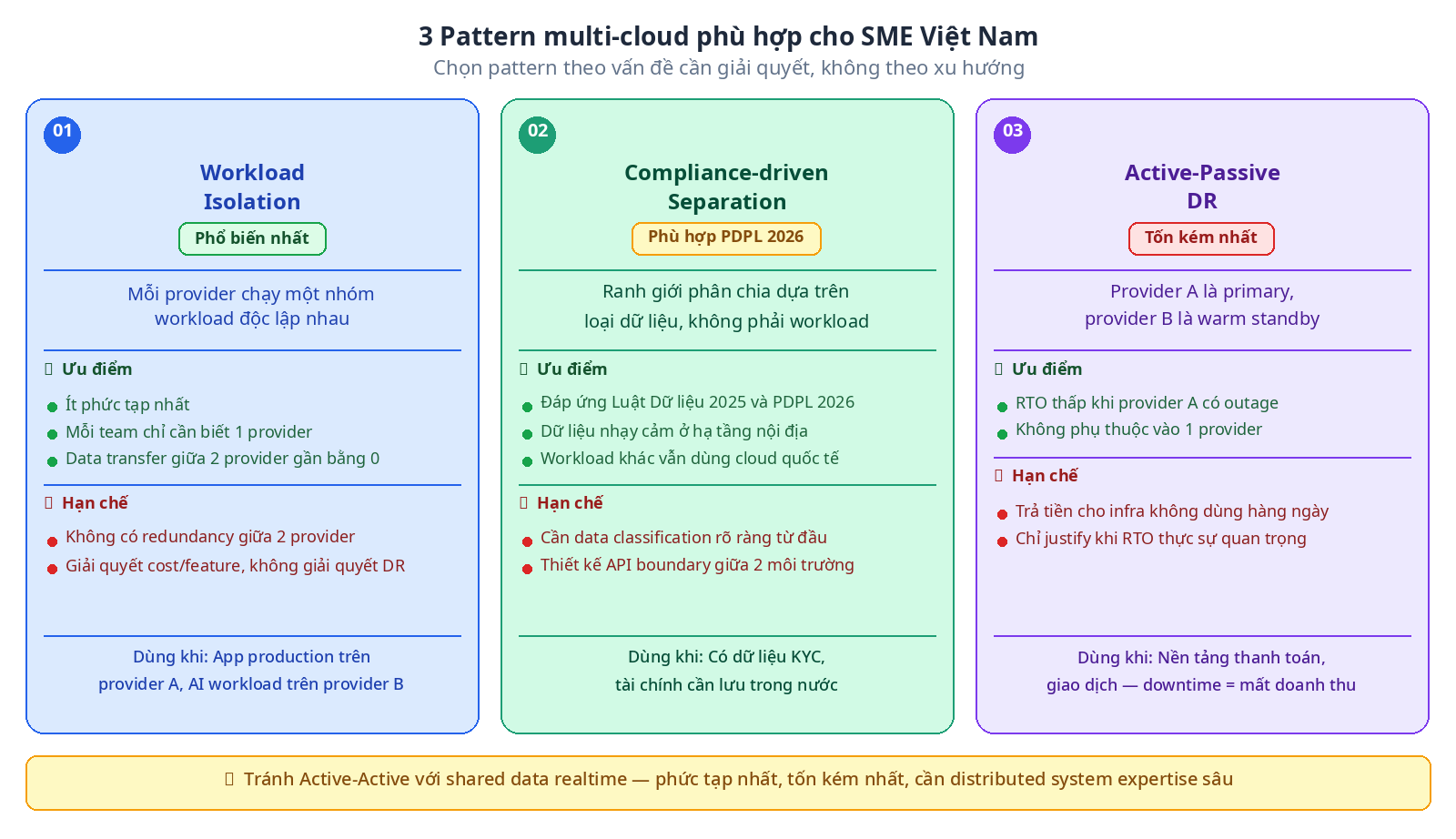
If you have worked through the checklist above and decided on multi-cloud, there are 3 common, practical patterns for SMEs:
Pattern 1: workload isolation (the most common)
Each cloud provider runs a different set of workloads, almost entirely independently. There is no regular data flow between the two providers.
Example: production app and database on provider A. AI training and model serving on provider B, which has better GPUs. The two sides communicate over APIs at acceptable latency and do not need real-time data sync.
This is the least complex pattern, because each provider operates as its own silo — team A knows provider A, team B knows provider B, and nobody needs deep knowledge of both.
Pattern 2: Compliance-driven separation
Workloads that process sensitive data (as defined by the Data Law 2025, Luật Dữ liệu 2025) run on a domestic provider. Non-sensitive workloads (static assets, CDN, dev environments) run on an international provider.
The boundary between the two providers is defined by data type, not by workload type. The data flow needs careful design so that no sensitive data leaks across to the foreign provider — this is the hardest part of the pattern.
Pattern 3: Active-passive DR
Provider A is primary and runs all of production. Provider B is a warm standby with data synced on a schedule. If provider A has a prolonged outage, you fail over to provider B.
This pattern is the simplest to run day to day but the most expensive, because you are paying for infrastructure that goes unused most of the time. It is only justified when the RTO requirement is genuinely low and the business case is clear.
The pattern SMEs should avoid: active-active with data shared in real time between two providers. This is the most complex architecture, the most expensive in egress and latency, and it demands distributed systems expertise that most SMEs do not have.
7. HiTechCloud plus an overseas cloud: a practical hybrid model
This is the specific pattern many Vietnamese SMEs and startups are adopting — not because it is the best solution in theory, but because it meets two practical requirements at once:
Requirement 1: compliance. Vietnamese user data, financial information and sensitive data must sit on domestic infrastructure under the Data Law 2025 (Luật Dữ liệu 2025) and the PDPL 2026.
Requirement 2: ecosystem and tooling. Some managed services, marketplaces or third-party integrations exist only on the international hyperscalers and are hard to replicate on a domestic provider.
8. How to split workloads in this pattern
On HiTechCloud (domestic VN):
- Workloads processing the personal data of Vietnamese users
- Production databases holding customer information
- AI/ML workloads withGPU(H100 GPUs at competitive pricing, with no cross-border data transfer for sensitive data)
- Backup and DR for critical data
- Workloads that need low latency for users in Vietnam
On international clouds:
- Workloads that do not handle sensitive data (static content, build pipelines, dev environments)
- A managed service that domestic providers do not offer, or have not matured
- Global CDN edge nodes (non-sensitive data)
- Offsite disaster recovery on request
9. What needs careful design
Classify your data clearly before you build. Every type of data needs to be classified: is it “important data” under the Law on Data 2025 (Luật Dữ liệu 2025)? If it is, it may only be processed on HiTechCloud. Skip this step and you will discover the compliance risk only after the architecture has been built.
An API boundary between the two environments. Services on an international cloud should not have direct access to databases holding sensitive data on HiTechCloud. All communication must go through APIs with full authentication and logging.
Centralized monitoring. Even with workloads running on two providers, you need a single monitoring dashboard so you are not checking two different consoles during an incident.
This model is not for everyone. It fits when you already have workloads running well on an international cloud and only need to add a compliance layer for sensitive data — not a full migration.
Conclusion: multi-cloud is not a destination, it is a tool
Multi-cloud is indeed a trend — but a trend among enterprises with large engineering teams and enough resources to manage the complexity. For most Vietnamese SMEs at their current stage, one good cloud provider, operated well, remains the superior choice in terms of overall ROI.
The right question to ask is not “should we adopt multi-cloud?” but rather: “what specific problem do we have, and is multi-cloud the least expensive way to solve it?”
If the problem is compliance, the answer is usually to add a domestic provider for the sensitive data — that is deliberate multi-cloud, not multi-cloud for its own sake.
If the concern is vendor lock-in, the answer is usually to write code to best practice (12-factor app, container-first, IaC) so that it stays portable — not necessarily to run on two providers today.
If the issue is cost, review your current bill and optimize before adding another provider.