
1. Practical solutions for IPv6-only
Since World IPv6 Launch on 6 June 2012, global IPv6 adoption has reached only 42.94% (APNIC Labs, February 2026). That suggests the end goal — an IPv6 single-stack (IPv6-only) internet — is still some way off. Although the technical approaches to moving to IPv6-only have been standardized and successfully deployed in many places, the pace of migration remains slow. Few countries have announced a concrete roadmap for retiring IPv4, and progress is particularly limited in enterprise and data center environments. To understand the transition to IPv6-only and the issues that remain, let us first review the most widely used IPv6-only transition techniques in use today.
The diagram below shows the general structure of a network system, which typically has three main components: End-User Equipment – Service Network – Border Equipment.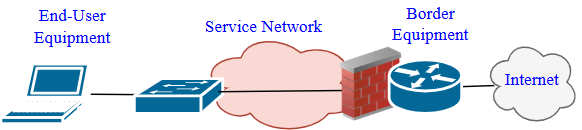
Figure 1: Overview of a network system
Border Equipment is the point that connects directly to the Internet, and because a large number of IPv4-only services still exist on the Internet, its outbound connectivity must remain dual-stack. There are therefore two models for migrating to IPv6-only:
Model 1: both end-user equipment and the service network run IPv6-only
Model 2: only the service network moves to IPv6-only, while user devices remain dual-stack.
Of the two models, model 2 is more flexible, easier to deploy and less disruptive to users, so it is the one usually adopted in practice.
There are currently three common groups of solutions for the transition to IPv6-only:
- DNS64 and NAT64: for public bodies, businesses and data centers
- 464XLAT: deployment in mobile networks
- DS-Lite, MAP-E and MAP-T: for fixed broadband networks
Of the three approaches above, DNS64/NAT64 follows model 1, while 464XLAT and DS-Lite/MAP-E/MAP-T follow model 2.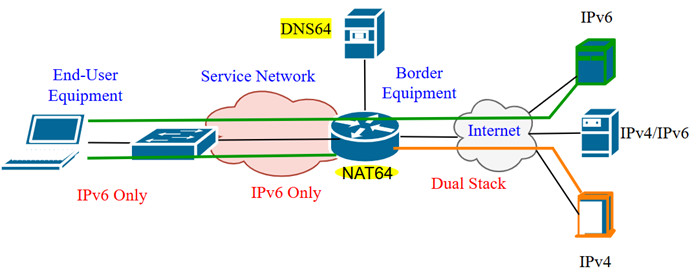
Figure 2: How the DNS64/NAT64 solution works
The DNS64/NAT64 solution allows IPv6-only devices to reach IPv4 servers by using DNS64 in the Service Network together with NAT64 at the Border Equipment. Enterprises wanting to experiment can use a public DNS64 service and deploy NAT64 with open-source software such as Jool if the Border Equipment does not yet support NAT64.
However, DNS64/NAT64 has a limitation: applications that use IPv4 literal addresses (IPv4 directly instead of a domain name, e.g., pinging 8.8.8.8), or applications that do not yet support IPv6, will not work. This is why the 464XLAT solution was proposed and has become the standard in mobile networks, where the shift to IPv6-only has advanced rapidly.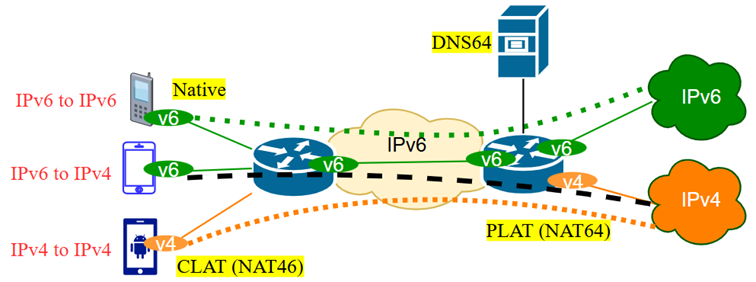
Figure 3: How the XLAT464 solution works
The 464XLAT solution fully addresses three connection types:
IPv6 → IPv6: uses native IPv6
IPv6 → IPv4: uses DNS64/NAT64
IPv4 → IPv4: handled by CLAT (NAT46) running on the user's own device
Android, iOS and macOS all support CLAT today, while Windows and Linux still lack full support. That is a significant obstacle to IPv6-only migration in government agencies and businesses, where endpoints are predominantly Windows.
2. Windows CLAT enters private preview
For years, Windows supported CLAT only on cellular interfaces, not on Ethernet or Wi-Fi — the two connection types most common in government agencies and businesses. That left a substantial gap: even where the service network can run IPv6-only, Windows end-user equipment is often still tied to IPv4-literal and IPv4-only applications, which makes a full IPv6-only model difficult to deploy.
Recognizing an urgent need from the community, in March 2024 Microsoft conducted a survey on extending CLAT support to non-cellular connections for Windows 11. This move was highly anticipated, as it directly addresses the most significant bottleneck for IPv6-only adoption in enterprise and campus environments.
After more than a year of waiting, on 18/11/2025 Microsoft officially announced that Windows CLAT had entered “Private Preview” (Source: https://techcommunity.microsoft.com/blog/networkingblog/windows-clat-enters-private-preview-a-milestone-for-ipv6-adoption/4459534).
Microsoft is also inviting partners and customers to register for the trial, with a roadmap that continues toward general availability (GA) — the point at which the feature ships as a formal part of Windows.
This is regarded as a historic milestone for the IPv6-only transition, since Windows is the operating system with the largest market share among enterprises, government agencies, and educational institutions. With Windows fully supporting CLAT, an IPv6-only model built around an IPv6-only Service Network becomes more feasible than ever.
Beyond Windows, other operating systems support CLAT to varying degrees:
- BSD: supported via the ipfw tool
- macOS: Apple has supported CLAT since macOS 13
- Linux: no official support yet; third-party tools such as clatd can be used
- Android and iOS: have supported CLAT for years and are the foundation of large-scale IPv6-only rollouts in mobile networks
CLAT support status across operating systems is summarized in the IETF Internet-Draft:
https://www.ietf.org/archive/id/draft-nbrr-v6ops-clat-status-00.html
The Windows CLAT Private Preview is more than a technical announcement — it is a signal that the operating system ecosystem is increasingly aligning with IPv6-only architecture. As a result, deploying IPv6-only within enterprises and organizations no longer faces the same systemic obstacles as before.
3. Practical lessons from VNNIC and Vietnam's national IPv6-only roadmap
In 2025, VNNIC, Vietnam's NIR, ran an IPv6-only pilot using DNS64/NAT64 on its office network. The results showed that most platform services — web, email, streaming and internal applications — worked reliably, with no significant problems. A number of issues did come up during the rollout, but VNNIC was able to resolve all of them.
One problem VNNIC could do nothing about is that some websites publish an AAAA record in DNS while the web server itself has no IPv6 configured, or IPv6 is disabled at the application layer or on the reverse proxy. As a result, when DNS64 returns an AAAA record to an IPv6-only device, Windows cannot establish a connection, while Android and iOS still connect normally thanks to CLAT (DNS64 returns both A and AAAA records, so Happy Eyeballs can fall back to IPv4). This shows that even when the network infrastructure is ready, a lack of operating system support leaves the move to IPv6-only blocked by a systemic technical bottleneck.
Windows' lack of CLAT support affects more than individual organizations — it has a direct bearing on national migration plans. Vietnam has published a roadmap to move to IPv6-only and switch off IPv4 between 2026 and 2030, an ambitious and strategically significant target. Given that most endpoint devices in businesses and government agencies run Windows, the absence of CLAT creates obstacles that DNS64/NAT64 cannot fully resolve.
Microsoft's announcement that Windows CLAT has entered private preview is therefore particularly significant. It signals Microsoft's support for the IPv6 migration plans of businesses, organizations and governments alike. Once Windows supports CLAT fully, deploying IPv6-only in companies and public agencies becomes both feasible and safer, reducing disruption and improving the reliability of the system as a whole.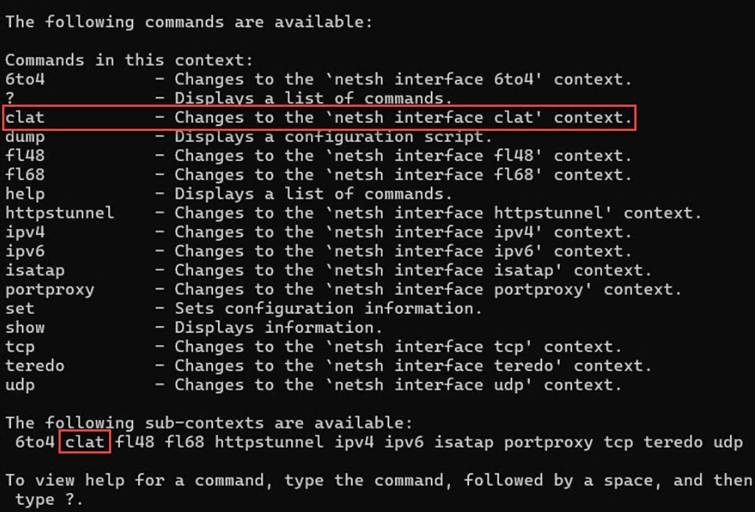
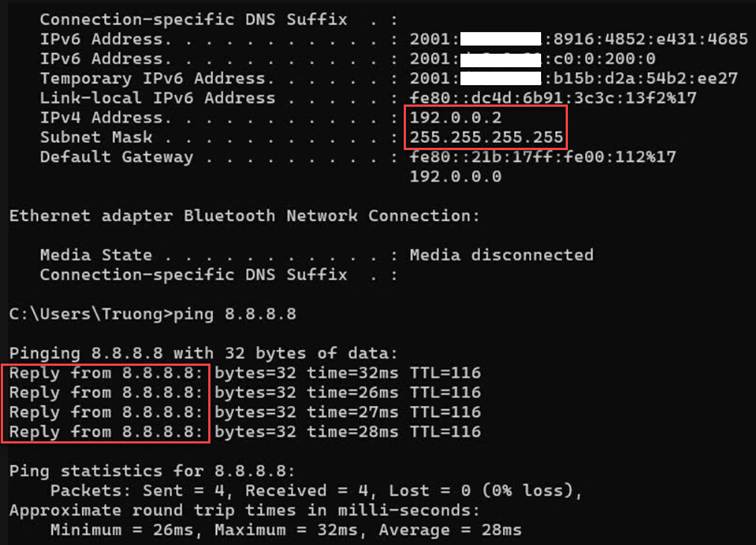
Figure 4: VNNIC's CLAT test results on Windows Insider Preview
Microsoft is also calling on the community to sign up for testing and provide feedback during the Private Preview phase, with Public Preview expected to arrive in 2026. Participation from the technical community — from ISPs and enterprises to government agencies — will determine how quickly this feature matures and becomes widely adopted.
More broadly, sustainable progress toward IPv6-only cannot depend on a single operating system. After Windows, the Linux ecosystem also needs CLAT support directly in the kernel, rather than relying on external tools such as clatd. Only when all the mainstream operating systems support CLAT natively will the move to IPv6-only genuinely shed its technical constraints and become consistent, stable and platform-independent.
Windows CLAT support makes IPv6-only a realistic proposition for enterprises and national systems. This is the moment for the technical community to test, give feedback and push the IPv6 ecosystem faster toward a single-stack model.