Both are virtual servers, but Cloud Server is now rated more highly for the advantages it offers over VPS.
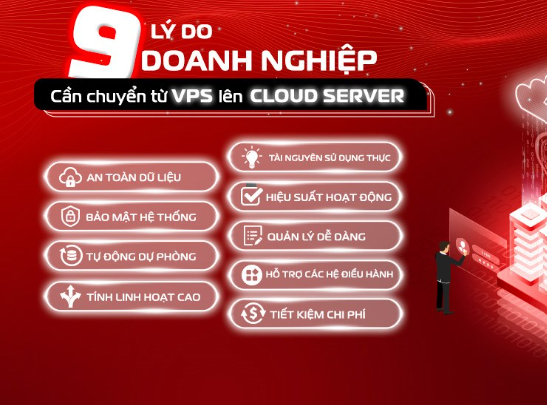
9 reasons businesses should move from VPS to Cloud Server
Still weighing up Cloud Server against VPS for your business? Here are the nine main reasons to move from VPS to Cloud Server:
1. Strong data safety
VPS: The risk of hardware failure and data loss on a physical host is always present. If another customer's VPS on the same node is hit by malware, your VPS can be affected as well.
Cloud Server:Because of how it stores data and operates on cloud computing infrastructure, a Cloud Server has every component set up with redundancy and automatic failover, keeping the system running 24/7 with high safety and availability — even in the event of drive failures, viruses, or unforeseen natural events.
2. System security
VPS: Operation depends on a single physical host, so the security measures depend on that host as well.
Cloud Server: Security is rated higher thanks to the security built into the virtualization infrastructure.
3. Automatic redundancy
VPS: It is created on, and depends on, a single physical host. If that host fails - power loss, hardware failure, an attack, a natural disaster - the VPS stops running as well.
Cloud Server: Because it does not depend on any single physical server but instead runs on a cloud computing platform, a Cloud Server always delivers high availability. If one physical server in the cluster that forms the cloud infrastructure fails, redundancy mechanisms ensure other physical servers automatically take over, keeping the system available 24/7/365.

Cloud Server consistently delivers high availability
4. High flexibility
VPS:A VPS's underlying physical server resources are limited and usually shared among multiple customers. If you want to scale resources up or down, you may need to move to a different physical server, which can disrupt service and cost time and money to upgrade the system.
Cloud Server: It offers a large resource pool, consistent capacity for traffic and straightforward upgrades on request. Providers' automated management software lets a business provision services quickly and scale its configuration as needed.
5. Actual resource usage
VPS: A business still pays for resources on the physical server that go unused. And if another customer on the same node demands more resources than they are allotted, they can encroach on your VPS's share, leaving your VPS short on resources — especially during peak hours.
Cloud Server:Cloud Server instances run independently, so your resources are not shared with anyone else and your system is not affected by other users.
6. Operating performance
VPS:Performance can be limited by the capacity of the host server. At peak times the physical host can hang, taking the VPS offline
Cloud Server:Cloud Server's cloud computing technology is based on a distributed architecture that draws on idle resources in one location to handle demand in another, keeping the system stable and delivering 99.99% uptime.
7. Easy management
VPS: Requires server resources to be managed and configured individually.
Cloud Server: Manage everything easily through a dashboard interface, with management methods to suit the situation — from the web portal to API protocols such as Remote Desktop and SSH, and even from mobile devices.
8. Supported operating systems
VPS:Different VPS instances on the same physical server must share a single operating system. A business that needs a different operating system has to move to another physical server, and the VPS is interrupted while it does so.
Cloud Server: Allows a flexible choice of operating system, because each VPS runs independently and does not depend on other VPS instances.
Lets you choose the operating system freely, because each virtual server runs independently of the others
9. Cost savings
VPS:A business has to pay for the VPS configuration it has purchased, even if demand later changes and actual resource usage is far below the amount purchased.
Cloud Server: Businesses pay only for what they actually use (CPU, RAM, HDD and so on, configured to requirement). Thanks to its flexibility and high availability, a business can also save on staffing costs, systems and service downtime.
Cloud Server is becoming an inevitable direction for businesses today. Built on a public cloud infrastructure solution, with high performance from latest-generation CPUs and high-speed SSD storage, Hi-Tech Cloud Server fromHi-Tech Cloudis considered a reliable, highly stable solution for businesses of every kind.
To find out more about the service, please contact Hi-Tech Cloud:
– Hotline: 0865.920.041
– Fanpage: https://www.facebook.com/photuesoftwarevietnam
– Website: https://hitechcloud.vn