Software-Defined Storage (SDS) is an effective way for businesses to make their data storage operations more efficient. In this article, HITECHCLOUD looks in detail at what SDS is and why it matters to a business.
What is software-defined storage (SDS)?
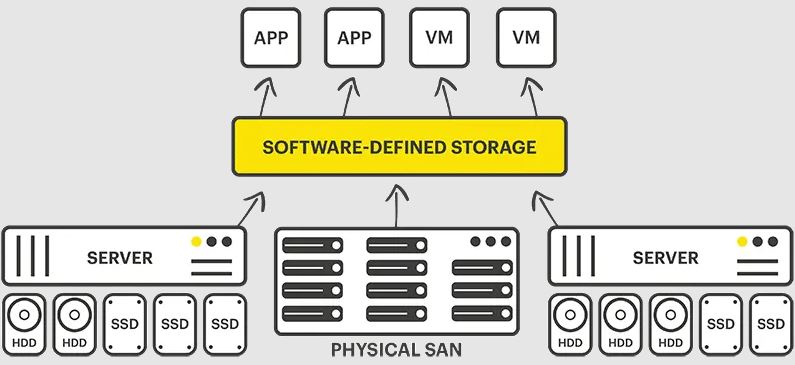
Software-Defined Storage (SDS) is a software-based approach to managing data storage. Rather than relying entirely on physical hardware such as hard drives or traditional storage devices, SDS decouples the storage function from the underlying hardware by using software to control, manage, and optimize storage resources.
SDS lets users customize how data is stored, accessed, and managed. This means users can combine different types of storage devices, from traditional hard drives to cloud storage solutions, without being locked into any specific vendor or technology.
With the rise of cloud computing and the demand for flexible storage, SDS has developed into a well-suited solution. The technology lets a business scale storage capacity up or down as required without replacing the entire hardware platform.
Why does SDS matter so much for businesses?
SDS is not simply a technology solution; it is a decisive factor in keeping a business competitive and performant. Below are several reasons why SDS has become a leading choice for organizations today.
– Flexibility and scale: a business can expand storage capacity easily without changing the whole system. Adding new storage devices is also far simpler thanks to the software-defined architecture.
– Cost savings: SDS reduces the costs of buying and maintaining hardware. By using software to manage storage, a business can make use of its existing storage devices instead of investing in expensive new solutions.
– Stronger security and reliability: SDS lets a business define more flexible security policies in software. The system can encrypt data automatically and apply access controls to protect sensitive information.
How does software-defined storage (SDS) work?
SDS is built on virtualization, letting users manage and access data more efficiently.
– Data virtualization principle: SDS uses virtualization technology to separate data from the underlying physical hardware. This means users can work with data without needing to know where or in what form it is stored. Virtualization lets users organize data however they want, optimizing performance and access speed.
– Intelligent management: SDS uses intelligent software to monitor and analyze storage activity. This lets users optimize how data is stored and accessed, more effectively than before.
– Integration with other technologies: SDS can integrate with a wide range of other technology solutions, including cloud computing, Big Data and the Internet of Things (IoT). This opens up further opportunities for businesses to store and process data.
Current SDS categories
There are now several different types of SDS to match the needs and requirements of each business. Each type has its own characteristics and applications, so users can select the solution that fits best.
– Cloud-based SDS: this type of SDS is integrated primarily with cloud platforms, giving businesses flexible, cost-effective data storage. With cloud-based SDS, data can be accessed anywhere and at any time, as long as there is an internet connection.
– On-premises SDS: on-premises SDS lets a business manage data directly on storage devices at its own facilities. It is typically used by businesses with high security requirements or a need for tighter control over their data.
– Hybrid SDS: hybrid SDS combines cloud-based SDS with on-premises SDS. It lets a business move data flexibly between the two environments, optimizing both cost and performance.
What major benefits does software-defined storage (SDS) deliver?
As businesses become more dependent on data, adopting SDS brings a number of benefits.
Increase performance and access speed
By optimizing automatically how data is stored and accessed, SDS improves storage system performance substantially. Users reach their data faster, which in turn improves productivity.
Easy to manage and maintain
SDS provides a management interface that is clear and easy to use, so administrators can monitor and manage storage resources without difficulty. Updating, configuring and maintaining the system becomes simpler, easing the load on the IT team. Users can also make changes without taking the system down, so business operations are not interrupted.
Strengthen resilience
One of the key benefits of SDS is data recoverability. Automated backup and restore features let a business keep its data protected and recover it easily if an incident occurs.
Limitations of SDS
SDS brings real benefits, but it has limitations too. The issues a business may run into when adopting SDS are set out below.
Requires high technical expertise
Deploying and managing SDS can require staff with deep technical expertise. A business needs to invest in training and developing its IT team in order to apply the technology effectively.
Upfront investment cost
Although SDS saves money over the long term, the initial investment can be high. A business has to pay for the software and for systems integration, which can be difficult for small and medium-sized companies.
Compatibility with legacy systems
One of the biggest challenges in adopting SDS is compatibility with legacy storage systems. Integrating SDS into an existing storage estate can be difficult and may disrupt operations.
The future development of SDS
As technology continues to advance, the future of SDS has more still to offer.
– Artificial intelligence (AI) integration: one notable future trend is the integration of artificial intelligence into SDS. AI can help optimize storage processes and analyze data more intelligently.
– Growth in cloud environments: Demand for cloud storage will keep growing, and SDS will continue to improve the performance and security of cloud storage solutions. Businesses can expect further development of multi-cloud storage solutions, giving them the flexibility to move data easily between different platforms.
– Stronger security and data protection: security will remain a leading concern in data storage. SDS will need to add new security capabilities to keep data protected against emerging threats.
Conclusion
Given the advantages it delivers, SDS not only improves storage performance but also optimizes cost and data security. Some limitations remain, but with technology advancing continuously the outlook for SDS is promising.
Applied correctly, SDS can become an important part of a company’s data storage and management strategy, helping it hold its competitive position in an increasingly tough market.